
photovoltaic systems أنظمة الطاقة الشمسية
إظهار الرسائل ذات التسميات photovoltaic tutorials. إظهار كافة الرسائل
إظهار الرسائل ذات التسميات photovoltaic tutorials. إظهار كافة الرسائل
الثلاثاء، 3 أكتوبر 2017
Training on Photovoltaic Systems - Session 3 - Plant Operation
Training on Photovoltaic Systems - Session 3 - Plant Operation

Training on Photovoltaic Systems - Session 4 - Maintenance [webiner]
Training on Photovoltaic Systems
Session 4 - Maintenance
الجمعة، 9 يونيو 2017
الثلاثاء، 29 مارس 2016
Video tutorials on RETScreen
Video tutorials on RETScreen provided by the Clean Energy Institute of GPEKS.

RETScreen 4 Tutorial 06: Background on RETScreen
- Presentation of 20 MW Wind Project: Initial Results
- Impact of Relocating the project (with higher wind resource) Cost scenarios Energy rates & other incentives Debt terms
RETScreen 4 Tutorial: Solar Photovoltaic (PV) Project Analysis Grid-Connected
This video is a hands-on visual demonstration of performing a RETScreen analysis for a Grid-Connected carport 15 to 20 kW in California. This tutorial will guide you step by step through the process of using RETScreen 4 to conduct a preliminary analysis for a residential/commercial scale system. It will describe in detail some key inputs. This demo will show the impact of using 20, 25 or 45 year life cycle. The analysis will cover a RETScreen 4 analysis type method 2 and will cover both a fixed array and tracker array. Note that this is one of 5 case studies covered in the Leonardo Academy course designed by the Clean Energy Institute of GPEKS, and that the full course contains extensive written documentation and a step by step document covering in greater details the material shown
in the video.
Introduction to the RETScreen
This video covers:
- Potential for Renewable Energy
- Importance of Due Diligence
- RETScreen as Due Diligence Tool
- Why are the Leonardo Academy courses different from other Leonardo Academy courses
- Quick tour of the Leonardo Energy Courses
- Benefits of Passing the Leonardo Academy Exams
Solar Photovoltaic (PV) Project Analysis with RETScreen

In this video, we will start by explaining applications for Solar PV.
We will review the main components of PV systems, such as what people call -panels- and various electronic and other components.
We will discuss central versus isolated-grid, benefits as well as limitations of various PV integration approaches.
Then we will cover economical aspects and specific configuration options for Off-grid systems
Special attention will be given to benefits and applications for Water Pumping systems driven by Solar PV
We will then examine what Solar Resource can be expected based on location; season of use and how the resource can be best captured using devices that follow the sun path.
The next slide will explain that based on PV system use, various types of seasonal or diurnal solar correlation may impact the design of PV systems.
Since one of the main goals of RETScreen analysis is to find out the economics of PV systems, we will off course discuss PV System and energy costs.
Besides equipment and energy costs, there are many considerations that may affect the viability of a PV projects and we will introduce some of the traditional considerations.
The next series of slides will provide illustrate applications of solar PV in various parts of the world.
Finally, we will introduce the RETScreen PV model and explain what is covered by the tool.
The logical path of how the model makes energy calculations will be shown.
We will explain why RETScreen's accuracy is appropriate for financial due diligence.
In conclusion, we will summarize the benefits of RETScreen for Due Diligence on Solar PV
Projects.
الأحد، 27 مارس 2016
Solar Energy System
Solar Energy System
Solar energy is the cleanest and most available renewable energy source. The Modern technology can harness this energy for a variety of uses, including producing electricity, providing light and heating water for domestic, commercial or industrial application.
Solar energy can also be used to meet our electricity requirements. Through solar photovoltaic (SPV) cells, solar radiation gets converted into DC electricity directly. This electricity can either be used as it is or can be stored in the battery. In this article we are going to see all about the solar energy. Let’s see step by step:
Solar Photovoltaic (SPV) Cell:
A solar photovoltaic or solar cell is a device that converts light into electric current using the photoelectric effect. SPVs are used in many applications such as railway signals, street lighting, domestic lighting and powering of remote telecommunication systems.
It has a p-type of silicon layer placed in contact with an n-type silicon layer and the diffusion of electrons occurs from the n-type material to the p-type material. In the p-type material, there are holes for accepting the electrons. The n-type material is rich in electrons, so by the influence of the solar energy, the electrons move from the n- type material and in the p-n junction, the combine with holes. This creates a charge on either side of the p-n junction to create an electric field. As a result of this, a diode like system develops which promotes charge flow. This is the drift current that balances the diffusion of electrons and holes. The area in which drift current occurs is the depletion zone or space charge region that lacks the mobile charge carriers.
So in dark, the solar cell behaves like a reverse biased diode. When light falls on it, like diode the solar cell forward biases and current flows in one direction from anode to cathode like a diode. Usually the open circuit (without connecting the battery) voltage of a solar panel is higher than its rated voltage. For example a 12 volt panel gives around 20 volts in bright sun light. But when the battery is connected to it, the voltage drops to 14-15 volts. Solar photovoltaic (SPV) cells are made of extraordinary materials called semiconductors for example silicon, which is presently the most generally used. Essentially, when light strikes the cell, a certain bit of it is absorbed within the semiconductor material. This means that the energy of the absorbed light is transferred to the semiconductor.
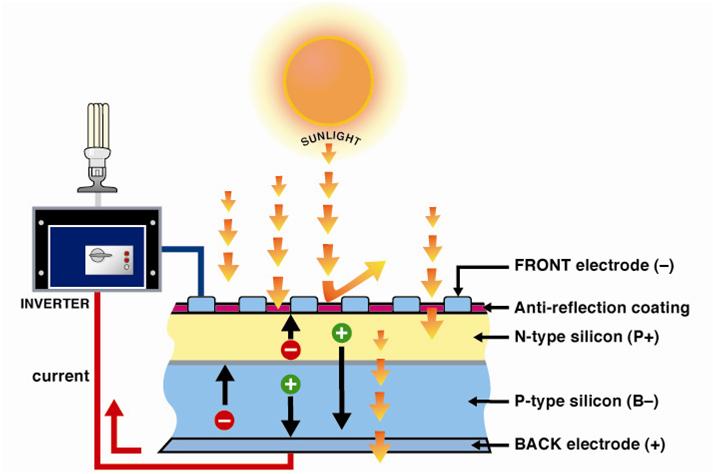
Solar PV cells also all have one or more electric fields that act to force electrons freed by light absorption to flow in a certain direction. This flow of electrons is a current and by placing metal contacts on the top and bottom of the SPV cell, we can draw that current off to utilize remotely. The cells voltage defines the power that the solar cell can produce. The process of converting light into electricity is called the solar photovoltaic (SPV) effect. An array of solar panels converts solar energy into DC electricity. The DC electricity then enters an inverter. The inverter turns DC electricity into 120-volt AC electricity needed by home appliances.
Solar Panel:
A solar panel is a collection of solar cells. The solar panel converts the solar energy into electrical energy. The solar panel uses Ohmic material for interconnections as well as the external terminals. So the electrons created in the n-type material passes through the electrode to the wire connected to the battery. Through the battery, the electrons reach the p-type material. Here the electrons combine with the holes. So when the solar panel is connected to the battery, it behaves like another battery, and both the systems are in series just like two batteries connected serially.
Output of the solar panel is its power which is measured in terms of Watts or Kilo watts. Solar panel with different output ratings is available like 5 watts, 10 watts, 20 watts, 100 watts etc. So before selecting the solar panel, it is necessary to find out the power requiring for the load. Watt hours or Kilowatt hours is used for calculating the power requirement. As a general rule, average power is equal to 20% of peak power. Therefore each peak kilo watt of solar array gives an output power that corresponds to the energy production of 4.8kWh / day. That is 24 hours x 1 kW x 20%.
Performance of the solar panel depends on a number of factors like climate, conditions of the sky, orientation of the panel, intensity and duration of sunlight and its wiring connections. If sunlight is normal, a 12 volt 15 watts panel gives around 1 ampere current. If properly maintained, a solar panel will last around 25 years. It is necessary to design the arrangement of solar panel on the roof top. Usually it is arranged facing the east at an angle of 45 degree. Solar tracking arrangement is also used that rotates the panel as the sun moves from east to west. Wiring connection is also important. Good quality wire with sufficient gauge to handle the current will ensure proper charging of the battery. If the wire is too lengthy, the charging current may reduce. So as a rule, the solar panel is arranged 10-20 feet height from the ground level. Proper cleaning of the solar panel once in month is recommended. This includes cleaning of the surface to remove dust and moisture and cleaning and re connection of the terminals.
The solar panel has totally of four process steps overload, under charge, low battery and deep discharge condition, let’s all them.
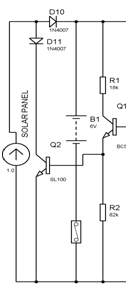
From the below circuit, we used a solar panel being a current source is used to charge the battery B1 via D10. While battery gets fully charged Q1 conducts from output of comparator. This results Q2 to conduct and divert the solar power through D11 and Q2 such that battery is not over charged. While the battery is fully charged the voltage at cathode point of D10 goes up. The current from solar panel is bypassed via D11 and the MOSFET drain and source. While the load is used by the switch operation Q2 usually provides a path to the negative while the positive is connected to the dc via the switch in the event over load. The correct operation of the load in normal condition is indicated by while the MOSFET Q2 conducts.
Application of Solar Energy:
From below Circuit, for controlling the intensity LED lamps can be fed with varying duty cycle from a dc source. The concept of intensity control helps saving of electrical energy. The LED’s used in combination with suitable driving transistors from the microcontroller duly programmed for a practical application.
In order to demonstrate the same from a 12v dc source 4 LED’s in series makes a string with 8*3=24 strings are connected in series with a MOSFET acting as a switch. The MOSFET could be IRF520 or Z44. Each LED is a white LED and operates at 2.5v. Thus 4 LED’s in series needs 10v. Therefore a resistor is connected with 10ohms, 10watts in series with the LED’s where the balance voltage is dropped from 12v by limiting the current for safe operation of the LED’s.
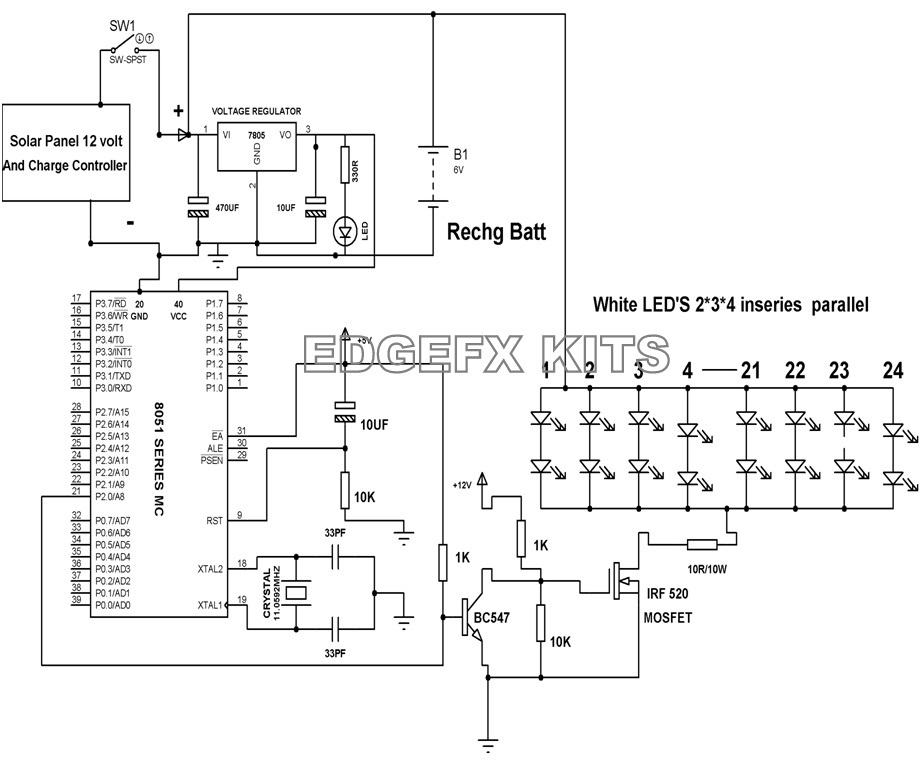
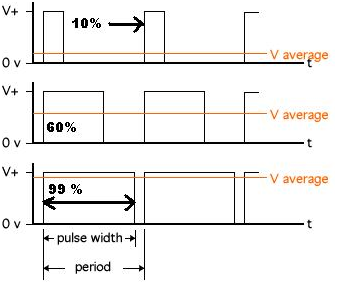
For example the LED lights used for the purpose of street lights are switched ON at the dusk with full intensity till 11pm with 99% duly cycle for the led’s i.e. 1% duty cycle from the controller. With each hour a advancing from 11pm the duty cycle for LEDs goes down from 99% progressively so that by the morning the ON time duty cycle reaches to 10% from 99% and finally to zero meaning the lights are OFF from morning i.e., from dawn to dusk. The operation repeats again from the dusk with full intensity till 11pm from 6pm and at 12 mid night it is 80% duty cycle, 1’o clock 70%, 2’o clock 60%, 3’o clock 50% ,4’o clock 40% and so on till 10% and finally OFF at the dawn.
The LED intensity changes according to pulse width modulation as shown in below fig.
https://www.elprocus.com/solar-energy-system/
الاشتراك في:
الرسائل (Atom)